- Call : +91 9540210956
- Email: [email protected]
- Artemis Hospital Sector 51 Gurgaon
- 09Am - 5Pm


Lung Biopsy: Is It Painful? Procedure, Risks, Recovery and Results
- Home
- Blog Details
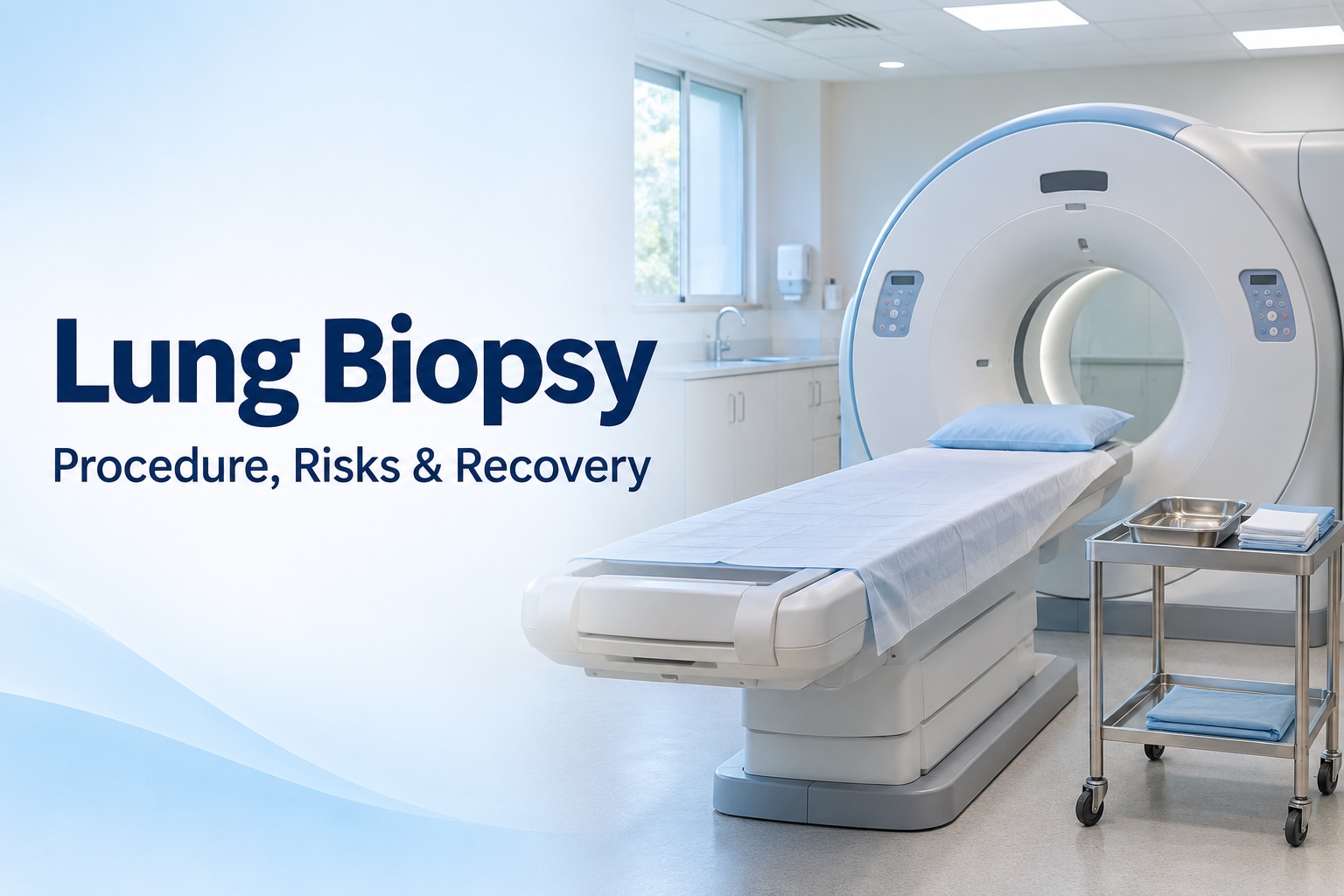
Being told you need a lung biopsy can raise more questions than the scan itself. Will it hurt? Can the lung collapse? Does a biopsy mean the doctor already knows it is cancer? And how long will you wait for an answer?
A lung biopsy takes a small sample for laboratory examination. It is a test to establish what an abnormality is, not a cancer diagnosis by itself. Different biopsy methods have different preparation, risks and recovery requirements. Knowing the exact procedure planned is the first step towards understanding your appointment.
This guide explains the options, with particular attention to CT-guided needle biopsy, the questions to ask before consent and what happens if the sample does not provide a definite answer.
Why Might a Lung Biopsy Be Recommended?
A scan shows an abnormal area's size, position and appearance, but it cannot always establish its cause. A sample may help distinguish cancer from infection, inflammation or another lung condition, and guide the next treatment decision.
RadiologyInfo's lung biopsy guide, produced by radiology professional organisations, explains this role. A biopsy is useful when the information is expected to change care and an appropriate sampling route is available.
Not every nodule needs an immediate biopsy. Ask what the team is trying to confirm, whether monitoring is an option and why sampling is recommended now. Our lung nodule guide explains the broader investigation pathway.
Which Type of Lung Biopsy Are You Having?
| Method | How it reaches the target | Important distinction |
|---|---|---|
| CT-guided needle biopsy | A needle passes through the chest wall under imaging guidance | Often uses local anaesthetic and observation afterwards |
| Bronchoscopy-based biopsy | A camera passes into the airways | The route depends on where the abnormality can be reached |
| EBUS-guided sampling | Ultrasound through a bronchoscope guides sampling near the airways | Commonly used for selected chest lymph nodes |
| Surgical biopsy | The surgeon obtains tissue through an operation, often using VATS | Has a different anaesthetic and recovery plan |
Cleveland Clinic's overview describes the main approaches. Ask for the full name of your procedure rather than preparing for a generic “lung test.” Our EBUS article explains that procedure separately.
What Happens During a CT-Guided Needle Biopsy?
The radiologist reviews imaging to plan a route, positions you on the scanner table and cleans the skin. Local anaesthetic is used before the sampling needle is introduced. CT images guide the needle towards the area that needs testing.
You may be asked to stay still or briefly hold your breath at particular points. Follow the team's instructions and tell them if you need to cough, move or take a break. The approach and position vary with the lesion.
MedlinePlus's lung needle biopsy information describes these steps. The time spent in the department includes preparation, imaging and observation, so it is longer than the time used to collect the sample.
Is a Lung Biopsy Painful?
Local anaesthetic can sting briefly as it is injected. During a needle biopsy, you may feel pressure or discomfort. You should tell the team if you feel pain rather than assuming you must tolerate it silently.
Some tenderness at the entry site can occur afterwards. A bronchoscopy or surgical biopsy has a different approach to comfort, sedation or anaesthesia. Leeds Teaching Hospitals' patient leaflet explains what to expect during an image-guided procedure.
Before the appointment, mention difficulty lying flat, significant breathlessness, severe anxiety or a previous problem with local anaesthetic or sedation. Ask how these needs will be accommodated in the specific procedure being proposed.
How Should You Prepare?
The hospital should give instructions tailored to the planned technique and whether sedation is expected. Fasting instructions are not identical for every biopsy, so follow your appointment information rather than a schedule found online.
- Provide a complete medication list, including blood thinners and diabetes treatment.
- Ask for individual instructions about any medicine that needs adjustment and when to restart it.
- Tell the team about allergies, possible pregnancy and existing lung conditions.
- Bring the requested scans, reports and recent blood tests.
- Check transport, escort and overnight-support requirements before attending.
Cambridge University Hospitals' needle biopsy guide explains preparation and the need to discuss relevant medicines. Do not stop prescribed anticoagulants or antiplatelet treatment on your own.
What Are the Main Risks?
The two commonly discussed risks of CT-guided lung biopsy are pneumothorax and bleeding. A pneumothorax occurs when air enters the space around the lung. A small leak may need observation; a larger or symptomatic one may need treatment such as a chest drain.
Bleeding may appear as blood-streaked sputum, but more substantial bleeding needs assessment. Other complications are less common and should be included in the consent discussion where relevant. The North Tees and Hartlepool CT-guided biopsy guide discusses this range.
Your risk depends on factors such as lung disease, the target and the planned route. Ask the operator to explain the risks for your case, how complications would be detected and what treatment is available if one occurs.
What does published research say about a collapsed lung?
A systematic review published in 2020 combined 36 studies with 23,104 patients. The pooled pneumothorax rate was 25.9%, while the rate of chest drain insertion was 6.9%. These describe different outcomes: detection of an air leak is not the same as needing a drain.
The studies used different techniques and included different patients. These pooled figures are not an individual prediction or a centre's current complication rate. Ask how the proposed biopsy's benefits compare with its particular risks and alternatives.
Why Do You Need Observation Afterwards?
After sampling, the team monitors your breathing and general condition and may obtain further imaging. The aim is to detect complications and establish that discharge is appropriate. The exact observation period depends on the protocol and your progress.
The Gloucestershire Hospitals biopsy information describes post-procedure monitoring. Do not plan the rest of the day around the assumption that you will leave immediately.
Before discharge, make sure you understand the written advice about activity, wound care, medicines and travel. If a drain or overnight stay is needed, the plan will change. Our chest drain guide explains what a drain is for.
Which Symptoms Need Urgent Help After Discharge?
New or worsening breathlessness, significant chest pain, substantial coughing up of blood, fainting or feeling acutely unwell needs urgent assessment. Follow your discharge team's emergency instructions and do not wait for the pathology appointment.
RadiologyInfo explains warning symptoms of a collapsed lung after needle biopsy. Complications are not excluded simply because the initial observation period was reassuring.
Keep the hospital contact number and procedure details available. Tell an assessing clinician when and where the biopsy was performed. If symptoms are severe, seek emergency care rather than trying to contact a routine booking office.
How Long Do Lung Biopsy Results Take?
Results are not normally available as soon as the sample is collected. The tissue must be processed and examined, and additional laboratory tests or specialist review may be needed. There is no reliable single turnaround time for every biopsy.
Kingston and Richmond's patient information explains that results are discussed through the referring clinical team. Ask for an expected timeframe, how you will receive the result and whom to contact if that date passes.
A delay does not, by itself, establish whether a finding is cancerous or benign. Request an update rather than trying to interpret the wait. Write down the follow-up arrangement before leaving the hospital.
Why Might Further Testing Be Needed on the Sample?
If a cancer is found, identifying its type may be followed by biomarker tests that help guide treatment. These are different questions from simply deciding whether abnormal cells are present.
The National Cancer Institute's biomarker-testing guide explains why sufficient tumor material matters. Sometimes a sample answers the initial diagnostic question but is not enough for every additional test.
Ask whether the laboratory work is complete, whether further results are pending and how those results affect the treatment discussion. Do not assume that the first pathology update is necessarily the final set of information.
Does an Inconclusive Biopsy Mean It Is Benign?
No. “Insufficient,” “nondiagnostic” or a nonspecific finding may mean that the sample has not resolved the question raised by the scan. The result has to be compared with imaging and the clinical history.
The American College of Radiology's guidance on indeterminate nodules discusses continued surveillance or repeat biopsy when concern remains. Another route, a surgical biopsy or planned imaging may be considered according to the situation.
Ask: “Does this result adequately explain the abnormality, and what is the plan if it does not?” A clear next step is more useful than interpreting the absence of a definitive diagnosis as reassurance.
Questions to Ask Before Agreeing to a Biopsy
- What exact abnormality are you sampling, and why?
- Why is this route suitable compared with the alternatives?
- Will I have local anaesthetic, sedation or a general anaesthetic?
- Which risks are increased by my lung condition or medication?
- How long should I plan to remain at the hospital?
- What symptoms should bring me back urgently?
- When and how will I receive the results?
- What happens if the sample is inconclusive?
Bring a written list so practical questions are not lost during consent. If you are seeking another opinion, bring the actual scan images as well as the report.
Frequently Asked Questions
Does a biopsy recommendation mean cancer is confirmed?
No. The purpose is to obtain information that imaging alone has not established.
Will I definitely need a chest drain?
No. A drain is needed for some complications, not every needle biopsy. Ask how your team assesses and manages that possibility.
Can I resume normal activity immediately?
Follow the instructions for your specific procedure and anaesthetic. Do not substitute another patient's discharge advice for your own.
Can one biopsy answer every question?
Sometimes further tissue or tests are needed. Ask whether the result is adequate for diagnosis and any additional treatment planning.
Arranging a Specialist Review
If you have a lung abnormality and need a thoracic surgical opinion about biopsy or the next step after a result, contact Dr. Parveen Yadav's team. Share your scans, biopsy report and procedure history. Acute symptoms after a procedure should go to the treating team or emergency care.
Selected Evidence and Patient Resources
- RadiologyInfo: needle biopsy, limitations and warning symptoms.
- Huo and colleagues, 2020: pooled pneumothorax and chest drain rates with variation between studies.
- National Cancer Institute: tissue and biomarker testing.
- Cambridge University Hospitals: practical preparation for CT-guided biopsy.

Dr. Parveen Yadav
18+ Yrs Exp | 5,700+ Thoracic & Robotic Cancer Surgeries
Dr. Parveen Yadav is a Director and Senior Consultant in Thoracic and Surgical Oncology, specializing in minimally invasive and robotic lung and esophageal surgeries, with advanced training from AIIMS and Tata Memorial Hospital.
View Full ProfileRecent Posts

Why Do I Cough After Eating or Drinking? Causes and When to Get Help
- Dr. Parveen Yadav
- Nov 15, 2026
Difficulty Swallowing Food and Liquids: Could It Be Achalasia?
- Dr. Parveen Yadav
- Nov 08, 2026

Coughing Up Phlegm Every Day? Causes, Tests and Bronchiectasis Treatment
- Dr. Parveen Yadav
- Nov 04, 2026
Hiatal Hernia or Acid Reflux? Symptoms, Treatment and When Surgery Is Needed
- Dr. Parveen Yadav
- Nov 01, 2026
Related Posts
Coughing Up Phlegm Every Day? Causes, Tests and Bronchiectasis Treatment
Daily mucus or repeated chest infections? Learn the causes of persistent phlegm, tests for bronchiectasis, treatment options and warning signs needing help.
- Read More
- Nov, 04 2026

Why Do My Hands Sweat So Much? Causes and Treatment for Sweaty Palms
Struggling with sweaty palms? Compare antiperspirants, iontophoresis, injections and ETS surgery, including when to seek help and the risks to discuss.
- Read More
- Oct, 28 2026
Rib Pain When Coughing: Causes, Warning Signs and Treatment
Why do your ribs hurt when you cough? Compare muscle strain, costochondritis and lung causes, with warning signs, tests and advice on when to seek help.
- Read More
- Oct, 02 2026
Copyright 2026 © Dr .Parveen Yadav all rights reserved.
Proudly Scaled by Public Media Solution!