- Call : +91 9540210956
- Email: [email protected]
- Artemis Hospital Sector 51 Gurgaon
- 09Am - 5Pm


Difficulty Swallowing Food and Liquids: Could It Be Achalasia?
- Home
- Blog Details
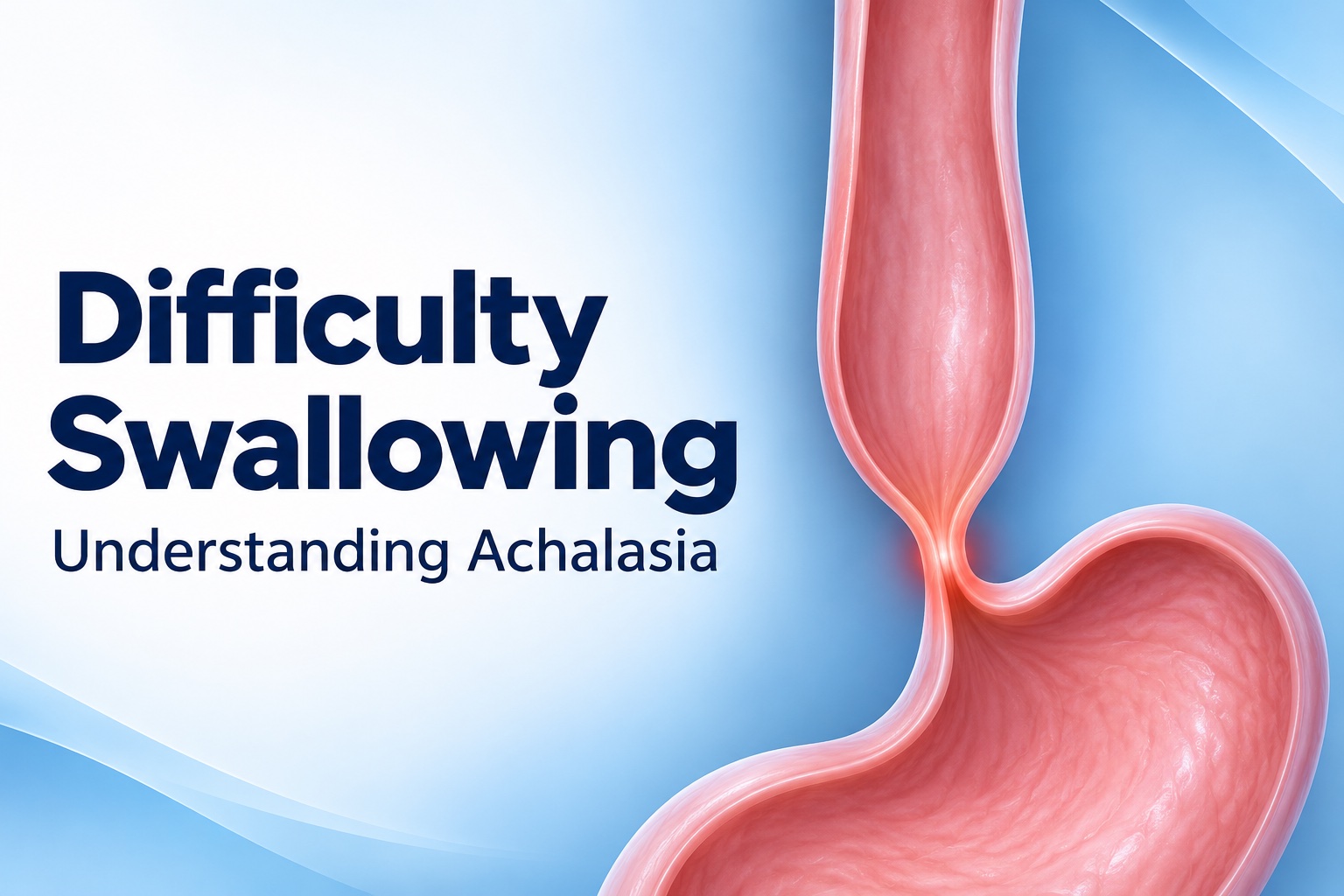
Food moves slowly through your chest, water sometimes feels difficult to swallow, and undigested food comes back up after a meal. You may have been treating the sensation as acidity, yet the swallowing problem continues. This pattern deserves an assessment rather than another assumption about reflux.
Achalasia is one possible cause of difficulty swallowing both food and liquids. It affects how the food pipe moves and how the valve at its lower end relaxes. It is not the only explanation, so the diagnosis needs tests that distinguish it from narrowing, inflammation and other conditions.
This guide explains the symptoms, the purpose of endoscopy and manometry, and how balloon dilation, Heller myotomy and POEM are compared when achalasia is confirmed.
What Happens in Achalasia?
The esophagus normally pushes a swallowed mouthful towards the stomach with coordinated muscle contractions. The lower esophageal sphincter, a ring of muscle at the junction, relaxes to let it pass.
In achalasia, normal movement is impaired and the lower sphincter does not relax adequately. Food and liquid can remain in the esophagus instead of entering the stomach efficiently. The food pipe may become enlarged over time.
The American Gastroenterological Association's patient guide explains this mechanism. Treatment aims to make passage into the stomach easier; it does not simply remove excess acid or guarantee restoration of normal nerve function.
Symptoms Worth Describing Clearly
Possible symptoms include difficulty swallowing solids and liquids, regurgitation of undigested food, chest discomfort and weight loss. Symptoms can develop gradually and may be mistaken for more familiar digestive problems.
The NHS achalasia guide also describes coughing or choking when food comes back up. Tell the clinician whether the problem occurs when starting a swallow, after the swallow reaches the chest, or both.
Useful details include whether liquids are affected, whether meals take longer, whether you avoid certain foods and whether food returns at night. Do not assume that managing by eating slowly means the cause no longer needs investigation. Our food-sticking article covers other explanations.
When Swallowing Difficulty Needs Urgent Help
If food is stuck now and you cannot swallow saliva, or you have breathing difficulty, seek emergency care. Do not keep eating or try to force the blockage down with drinks. Being able to breathe does not exclude an obstruction in the food pipe.
The American Society for Gastrointestinal Endoscopy's food-impaction guidance distinguishes complete obstruction requiring emergency treatment from other impactions needing urgent assessment.
Progressive swallowing difficulty, unexplained weight loss or repeated regurgitation also needs prompt review. The purpose is to establish the cause, not to assume that achalasia explains every swallowing symptom.
Achalasia and Acid Reflux Are Different
With reflux, stomach contents move backwards into the esophagus. With achalasia, impaired emptying can leave food and liquid above the lower sphincter. Both can produce symptoms described as burning or regurgitation, but treatment addresses different problems.
The American College of Gastroenterology's patient information discusses why achalasia can resemble reflux. Persisting symptoms despite acid treatment are a reason to reconsider the diagnosis, not proof that you need an antireflux operation.
Ask the clinician to separate your symptoms: heartburn, food sticking, liquid sticking and the return of undigested food. Our hiatal hernia and reflux guide explains the related but distinct anatomy.
Why Endoscopy Still Matters
Upper GI endoscopy allows the specialist to inspect the esophagus and stomach and look for another explanation for obstruction. A tight junction or retained food may raise suspicion, but the appearance alone does not always establish achalasia.
The 2020 ACG clinical guideline recommends endoscopic assessment to exclude other pathology, including pseudoachalasia: another condition that produces a similar outflow problem. Additional investigation may be needed when the clinical picture is concerning.
Tell the endoscopy team about regurgitation and retained food before the appointment, and follow their preparation instructions. Do not change a prescribed preparation plan based on someone else's experience online.
What Do Manometry and a Barium Swallow Show?
High-resolution esophageal manometry records pressures during swallowing. It assesses how the muscles contract and whether the junction relaxes appropriately. This helps confirm a motility disorder rather than guessing from symptoms.
The British Society of Gastroenterology's manometry guideline explains the value of pressure testing in swallowing problems. It answers a different question from endoscopy: seeing the lining does not show the full pressure pattern.
A barium swallow shows the passage and shape of the esophagus during X-ray imaging. A timed study measures how well swallowed contrast empties. The UEG/ESNM achalasia guideline describes this complementary role. Ask whether the tests agree and what any uncertain result means before choosing a procedure.
Why the Achalasia Subtype Changes the Discussion
Manometry classifies achalasia into patterns commonly called type I, type II and type III. These describe pressure and contraction findings, not stages of cancer or a simple scale from mild to severe.
| Subtype | Main pattern | Question for the specialist |
|---|---|---|
| Type I | No normal peristalsis, without substantial pressurisation | Which method will relieve the outflow problem in my case? |
| Type II | Pressurisation across the esophagus during swallowing | How do the suitable treatment options compare? |
| Type III | Spastic contractions with impaired junction relaxation | Does the spastic segment need a longer, tailored myotomy? |
The ACG guideline explains why subtype is useful for prognosis and treatment selection. Ask to see the manometry conclusion rather than relying only on the word “achalasia.”
Comparing the Main Treatment Options
The main procedures reduce resistance at the lower esophagus. Choice depends on the subtype, earlier treatment, fitness, preferences and expertise available. Symptom relief must be weighed alongside reflux and the possibility of another procedure later.
Pneumatic dilation
A specially designed balloon is inflated across the lower sphincter to disrupt the tight muscle. A graded course or repeat treatment may be needed. This is different from casually stretching a minor narrowing.
The ASGE achalasia guideline describes pneumatic dilation among established options. Perforation is a recognised risk, so ask how complications would be managed and whether repeated dilation fits your circumstances.
Laparoscopic Heller myotomy
The surgeon divides selected muscle fibres at the lower esophagus and onto the stomach to make passage easier. A partial fundoplication is commonly added to reduce reflux after the muscle barrier is loosened.
UCLA Health's achalasia guide explains the surgical approach. Ask about the planned myotomy, the wrap and how swallowing and reflux will be checked afterwards. This is an operation on the muscle; the food pipe is not routinely removed.
Peroral endoscopic myotomy, or POEM
POEM is performed through the mouth using an endoscope. A tunnel is created in the esophageal wall so the muscle can be divided without external incisions. Its ability to tailor a longer myotomy is relevant to spastic disease.
Leeds Teaching Hospitals' POEM guide explains the procedure and alternatives. It is still an invasive procedure with preparation, anaesthesia and recovery requirements. Having no skin incision does not mean there are no complications.
What Do Comparative Studies Show?
A 2019 randomised trial compared POEM with Heller myotomy plus Dor fundoplication. At two years, clinical success was 83.0% after POEM and 81.7% after surgery. Reflux esophagitis on endoscopy was more frequent after POEM: 44% versus 29% at that point.
The five-year follow-up published in 2025 reported clinical success of 75.0% after POEM and 70.8% after Heller myotomy. The difference was 4.2 percentage points, with a 95% confidence interval from −7.4 to 15.7; this does not establish that POEM is superior for every patient.
These studies use defined success criteria, not a promise of cure. The useful question is how their results apply to your subtype, previous procedures and priorities, including the need to manage reflux.
How Current Guidance Helps With the Choice
The 2024 SAGES update suggests either POEM with appropriate proton pump inhibitor use or Heller myotomy with fundoplication for adults with type I or II disease, based on shared decision-making. This is a conditional recommendation with low-certainty evidence.
For type III, the panel favours POEM over Heller myotomy as expert opinion. It also conditionally suggests POEM over pneumatic dilation, based on moderate-certainty evidence. These qualifications matter: a guideline preference should support, not replace, a discussion of your individual options.
Ask whether a centre can discuss the alternatives fairly, including referral if a suitable procedure is not available locally.
What About Botox or Tablets?
Botulinum toxin can temporarily relax the lower sphincter and may be useful when a more durable procedure is unsuitable. Medicines have a more limited role. The AGA patient guide discusses these options and why they may not provide the same lasting relief as the main procedures.
Ask why a temporary approach is being suggested and what the plan is if symptoms return. Do not assume that receiving an injection means the underlying movement problem has been cured.
Recovery and Follow-Up Are Part of Treatment
Your team should provide a procedure-specific plan for restarting fluids and food, medicines, activity and review. Regurgitation and swallowing difficulty before treatment may also affect nutrition, so ask whether dietetic support is needed.
Follow-up should consider both improved emptying and reflux after treatment. If symptoms persist or recur, tests may be needed before repeating the original procedure. The UEG/ESNM guideline discusses reassessment rather than assuming that every later symptom has the same cause.
Seek prompt advice for inability to swallow fluids, persistent vomiting, fever or worsening chest pain after a procedure. Follow the discharge team's emergency instructions rather than simply returning to a liquid diet and waiting.
Questions for Your Consultation
- Is achalasia confirmed, and have other causes of obstruction been excluded?
- What is my manometry subtype?
- Which procedures are suitable given my tests and previous treatment?
- What reflux risk comes with each option?
- How will success be measured, and could I need retreatment?
- What diet and follow-up will I need?
- Whom should I contact if swallowing worsens?
Frequently Asked Questions
Does difficulty with liquids prove achalasia?
No. It is a useful symptom to report, but tests are needed to establish the cause.
Is achalasia cancer?
No. It is a motility disorder. Investigations still need to exclude other explanations for a similar swallowing problem.
Does treatment restore completely normal swallowing?
It aims to improve passage into the stomach. The response varies, and ongoing care or additional treatment may be needed.
Arranging an Appropriate Review
A gastroenterologist can investigate persistent swallowing problems. If myotomy or another operation is being considered, contact Dr. Parveen Yadav's team to discuss an appropriate surgical opinion. Bring endoscopy, barium and manometry reports as well as your treatment history.
Selected Evidence and Guidelines
- ACG guideline, 2020: diagnosis and subtype-based assessment.
- SAGES update, 2024: comparative treatment recommendations and evidence certainty.
- Randomised trial follow-up, 2025: five-year outcomes after POEM or Heller myotomy.
- AGA patient guide: symptoms and treatment expectations.

Dr. Parveen Yadav
18+ Yrs Exp | 5,700+ Thoracic & Robotic Cancer Surgeries
Dr. Parveen Yadav is a Director and Senior Consultant in Thoracic and Surgical Oncology, specializing in minimally invasive and robotic lung and esophageal surgeries, with advanced training from AIIMS and Tata Memorial Hospital.
View Full ProfileRecent Posts

Coughing Up Phlegm Every Day? Causes, Tests and Bronchiectasis Treatment
- Dr. Parveen Yadav
- Nov 04, 2026
Hiatal Hernia or Acid Reflux? Symptoms, Treatment and When Surgery Is Needed
- Dr. Parveen Yadav
- Nov 01, 2026

Why Do My Hands Sweat So Much? Causes and Treatment for Sweaty Palms
- Dr. Parveen Yadav
- Oct 28, 2026
Thymectomy for Myasthenia Gravis: Who Benefits, Surgery and Recovery
- Dr. Parveen Yadav
- Oct 25, 2026
Related Posts
Hiatal Hernia or Acid Reflux? Symptoms, Treatment and When Surgery Is Needed
Learn how a hiatal hernia differs from acid reflux, which symptoms need urgent care, what tests help and when repair or fundoplication may be considered.
- Read More
- Nov, 01 2026
Food Stuck in Chest: Causes, Warning Signs and When to Get Help
Food feels stuck in your chest after eating? Learn about reflux, narrowing, swallowing problems, warning signs and when urgent endoscopy may be needed.
- Read More
- Sep, 28 2026
Coughing Up Phlegm Every Day? Causes, Tests and Bronchiectasis Treatment
Daily mucus or repeated chest infections? Learn the causes of persistent phlegm, tests for bronchiectasis, treatment options and warning signs needing help.
- Read More
- Nov, 04 2026
Copyright 2026 © Dr .Parveen Yadav all rights reserved.
Proudly Scaled by Public Media Solution!