- Call : +91 9540210956
- Email: [email protected]
- Artemis Hospital Sector 51 Gurgaon
- 09Am - 5Pm


Thymectomy for Myasthenia Gravis: Who Benefits, Surgery and Recovery
- Home
- Blog Details
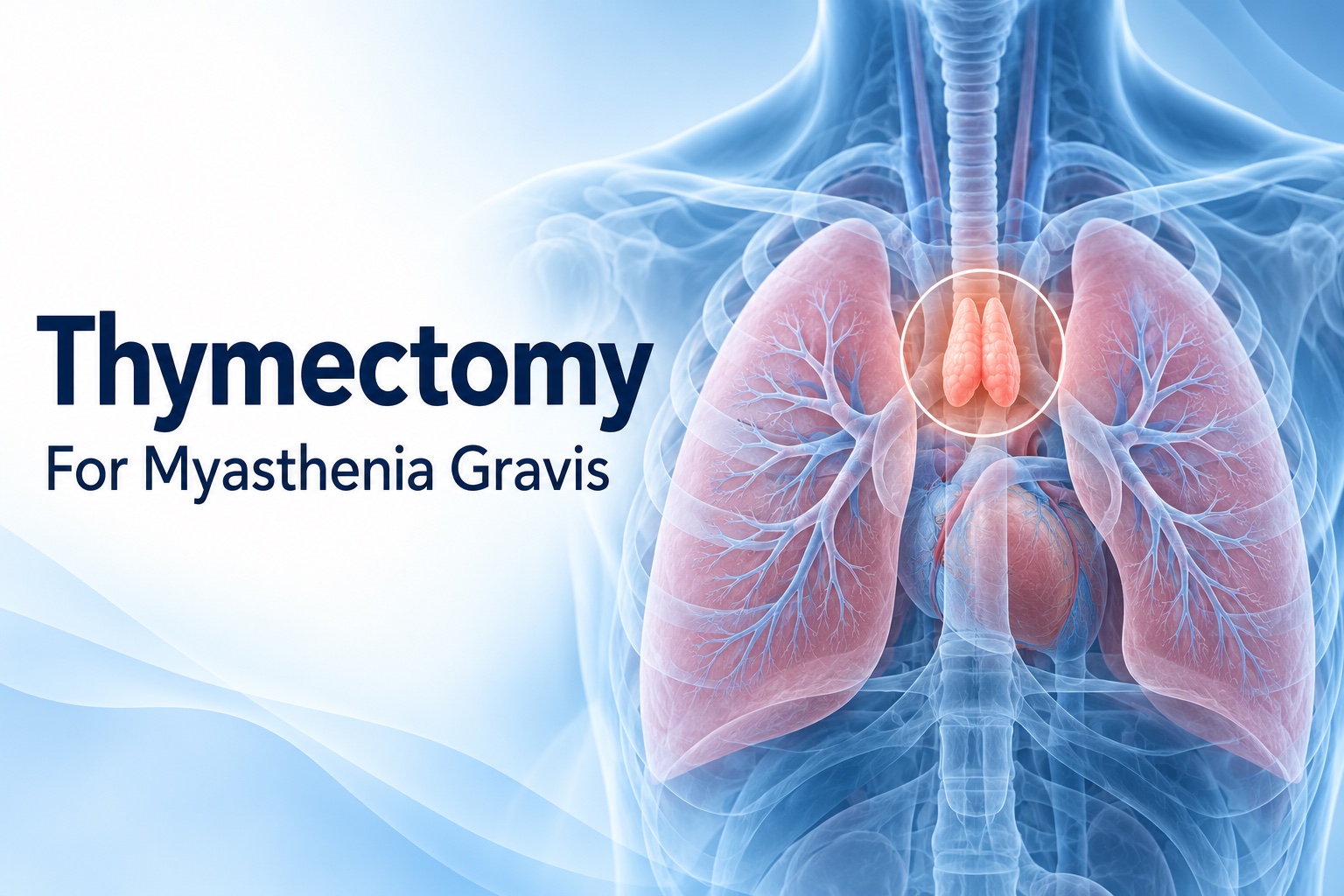
If you have myasthenia gravis and have been advised to see a thoracic surgeon, it is natural to wonder why a chest operation could help a condition that affects muscle strength. The explanation involves the thymus gland and its relationship with the immune system.
Thymectomy means surgical removal of the thymus. It can improve disease control in selected people with myasthenia gravis, but it is not an immediate or guaranteed cure. The reason for surgery must also be clear: removing a thymoma and treating non-tumor-associated myasthenia are related but different decisions.
This guide explains who may benefit, what the major trial actually showed, how newer guidance approaches surgery, and why preparation with a neurologist and anaesthetist matters.
How Are the Thymus and Myasthenia Connected?
Myasthenia gravis, or MG, is an autoimmune disorder that interferes with communication between nerves and muscles. In a common form, antibodies target the acetylcholine receptor, abbreviated to AChR. Weakness can affect the eyes, face, limbs, swallowing or breathing.
The thymus sits in the upper chest behind the breastbone and participates in immune-system development. In some people with MG it is involved in the abnormal immune response. Removing it can influence disease activity even when no tumor is present.
University of Maryland Medical Center's MG explanation describes the nerve-muscle junction and the thymus connection. Thymectomy is different from thyroidectomy: the thyroid is a separate gland in the neck.
Two Reasons for Thymectomy: Thymoma or MG Control
A thymoma is a tumor arising in the thymus. If one is identified, the team considers tumor treatment as well as the myasthenia. The extent of the tumor and whether it can be completely removed influence planning; some patients need additional oncology treatment.
The National Cancer Institute's thymic tumor guide explains this pathway. Removing a thymoma does not guarantee that MG disappears, so neurological care remains necessary. Read our thymoma and thymic carcinoma guide for the tumor-focused discussion.
Without a thymoma, the goal is different: to improve long-term MG control or reduce treatment burden in a patient likely to benefit. A normal-looking thymus does not by itself exclude this possibility.
Who Should Discuss Surgery With Their Team?
The 2025 Association of British Neurologists guidance emphasises early thymectomy in AChR-antibody-positive MG. It recommends surgery in patients below 50 and discussion in those aged 50–65, with the decision fitted to the clinical situation. For non-thymoma cases, it prefers consideration within two years of diagnosis, while allowing later consideration in selected circumstances.
The strongest randomised evidence concerns generalised AChR-positive disease, rather than every MG subtype. An older age, longer disease duration or another antibody pattern requires a more individual discussion, not a decision based on age alone.
Ask the neurologist to document your antibody result, whether the disease is ocular or generalised, and what benefit surgery is expected to add to your current treatment. “MG positive” is not enough detail for informed surgical planning.
What Did the MGTX Trial Demonstrate?
The MGTX randomised trial, published in the New England Journal of Medicine in 2016, enrolled 126 adults aged 18–65 with generalised, AChR-positive MG, no thymoma and disease duration below five years.
Participants received either extended transsternal thymectomy plus a standardised prednisone regimen, or prednisone alone. Over three years, the surgery group had a lower time-weighted average Quantitative MG score: 6.15 versus 8.99, where a lower score indicates less weakness. The average required alternate-day prednisone dose was also lower: 44 mg versus 60 mg.
These are trial averages across time, not medication instructions and not a percentage chance of cure. The study supports adding thymectomy for an appropriate patient; it does not show that everyone can discontinue medicines after surgery. Its eligibility criteria matter when applying the result to someone outside the trial population.
Did the Benefits Last Beyond Three Years?
A 2019 extension of MGTX found that the advantages in average weakness scores and prednisone requirements remained at five years. However, 68 of the 111 participants who completed the original trial entered the extension, and 50 completed the five-year assessment.
This smaller follow-up group supports persistence of benefit while limiting how confidently the exact results can be generalised. It is reasonable to discuss a long-term goal, but not to promise the same outcome for every patient.
Before surgery, agree what improvement would count as worthwhile for you: fewer disabling symptoms, reduced treatment burden or fewer exacerbations. Ask how those outcomes will be tracked at neurology follow-up.
What About Ocular, MuSK-Positive or Seronegative MG?
Ocular MG affects eye muscles without generalised weakness. It was not the population studied in MGTX. The international consensus guidance updated in 2020 allows thymectomy to be offered to selected AChR-positive ocular patients when standard treatment is inadequate, unsuitable or not preferred after an informed discussion.
MuSK-positive disease is a different antibody-defined form. Thymectomy is not routinely recommended for MG control in this group without a thymoma. Evidence in seronegative disease is also less secure and recommendations are not identical across guidelines.
A specialist neuromuscular review is particularly useful before surgery in these situations. Ask which evidence applies to your subtype and whether the reason for referral is a tumor, medication difficulty or an anticipated effect on MG itself.
Robotic, VATS or Open Thymectomy?
Open transsternal surgery reaches the thymus through the breastbone. VATS uses a camera and instruments through smaller chest incisions; robotic surgery uses surgeon-controlled instruments with a camera system. The aim is an appropriate removal of thymic tissue while protecting nearby structures.
Cleveland Clinic's procedure guide explains the approaches. The method depends on anatomy, any tumor, anaesthetic considerations and surgical experience. A robot does not operate independently.
The American Academy of Neurology's 2020 advisory noted uncertainty about whether the benefit demonstrated with extended transsternal surgery in MGTX could be assumed for minimally invasive techniques. Newer ABN guidance favours minimally invasive surgery when suitable. These statements address different aspects of the evidence: a current practical preference does not turn the original trial into a randomised comparison of approaches.
Ask why the proposed approach suits your case, what tissue will be removed and what circumstances might require conversion to open surgery.
Why MG Should Be Stable Before an Elective Operation
MG can affect breathing and swallowing, and anaesthesia adds specific considerations. The BJA Education review on perioperative MG management recommends coordinated assessment with the neurologist and optimisation before elective surgery.
The assessment includes current weakness, swallowing or speech problems, breathing symptoms, previous crises and medication use. Breathing tests, including forced vital capacity where appropriate, help plan perioperative care. Some patients need closer postoperative observation or ventilatory support.
Preoperative intravenous immunoglobulin or plasma exchange may be appropriate in selected patients, such as those with significant bulbar weakness; these treatments are not automatic requirements for everyone. Do not independently stop pyridostigmine, steroids or other MG treatment. Ask for written instructions for the fasting period and the day of surgery.
What Are the Main Surgical Risks?
Thymectomy is major surgery even when performed through small incisions. Risks include bleeding, infection, blood clots, pain and injury to nearby structures. Damage to the phrenic nerve can affect diaphragm movement and breathing.
UCLH's thymectomy information lists these complications. MG also creates a risk of postoperative weakness that needs a specific monitoring and treatment plan.
Ask your surgeon and anaesthetist to separate the risks of the operation from the risks related to your MG and other health conditions. A general complication figure cannot replace an explanation of your own assessment.
Recovery: The Wound and MG Improve on Different Timelines
In the first days, recovery focuses on pain relief, breathing, mobility, eating safely and checking for complications. You may have a chest drain. The exact hospital stay depends on the approach, MG stability and postoperative progress.
University Hospital Southampton's VATS and robotic thymectomy booklet describes practical recovery issues, including fatigue, pain relief and gradually returning to activity. Ask for personalised advice about work, lifting and driving.
The immune-related effect on MG can take much longer than healing of the incision. The NHS MG treatment guide explains that improvement may develop over months and continue over years, while some people experience little benefit.
Continue neurological follow-up even if you feel stronger. Medication reduction should be directed by the treating clinician, not triggered by discharge from hospital or an early good week.
Warning Signs That Need Urgent Help
Severe or rapidly worsening breathing or swallowing difficulty needs urgent hospital assessment. A myasthenic crisis can be life-threatening. Do not wait for a routine surgical appointment or assume the symptoms are ordinary postoperative tiredness.
The NHS overview of MG highlights this emergency pathway. Your discharge plan should also explain whom to contact for wound concerns, fever or increasing pain, and which symptoms require immediate emergency care.
Make sure a family member understands the warning signs and has the hospital contact details. Tell clinicians treating any new illness that you have MG and provide your current medication list.
What to Bring to a Thymectomy Consultation
- The neurologist's diagnosis and antibody reports.
- Chest CT or MRI images and reports.
- A medication list with doses, timing and significant side effects.
- A record of previous MG crises, admissions and rescue treatments.
- Recent breathing tests, if performed.
- Your goals and the practical support available during recovery.
Ask: “Is the operation for a thymoma, MG control or both?” Follow with: “What improvement is realistic, how will we assess it, and who will manage my medication afterwards?” These answers should form one coordinated plan.
Frequently Asked Questions
Can surgery help when the scan shows no thymoma?
Yes, selected patients may benefit without a tumor. The diagnosis and antibody subtype matter more than assuming a normal-looking gland has no role.
Will I stop all medicines immediately?
No such result can be promised. Arrange continued neurology care and follow the agreed medication plan.
Is robotic surgery proven to cure more patients?
Do not interpret the use of a particular device as a cure guarantee. Ask about the evidence, completeness of the planned operation and suitability for your circumstances.
Is surgery the only treatment for MG?
No. Medicines and other specialist treatments remain important. The decision is what surgery could add to a coordinated treatment plan.
Discussing Surgery With a Thoracic Specialist
If your neurologist has recommended a surgical discussion, book a consultation with Dr. Parveen Yadav and bring the complete investigation record. The purpose is to assess whether surgery fits your MG subtype, scan findings and overall health, with a clear perioperative plan.
Selected Research and Guidelines
- MGTX, New England Journal of Medicine, 2016: randomised trial in generalised AChR-positive, non-thymomatous MG.
- MGTX extension, Lancet Neurology, 2019: five-year benefit with a smaller follow-up cohort.
- Association of British Neurologists, 2025: updated selection, timing and surgical approach guidance.
- American Academy of Neurology, 2020: benefits and uncertainties in applying trial findings.
Dr. Parveen Yadav
18+ Yrs Exp | 5,700+ Thoracic & Robotic Cancer Surgeries
Dr. Parveen Yadav is a Director and Senior Consultant in Thoracic and Surgical Oncology, specializing in minimally invasive and robotic lung and esophageal surgeries, with advanced training from AIIMS and Tata Memorial Hospital.
View Full ProfileRecent Posts
Ground-Glass Lung Nodules: Follow-Up, Cancer Risk and When Surgery Is Needed
- Dr. Parveen Yadav
- Oct 21, 2026
Lung Function Tests Before Lung Surgery: FEV1, DLCO and Fitness Explained
- Dr. Parveen Yadav
- Oct 17, 2026
Does a Positive PET-CT Always Mean Lung Cancer?
- Dr. Parveen Yadav
- Oct 14, 2026
Chest Drain After Lung Surgery: Care, Removal and Recovery
- Dr. Parveen Yadav
- Oct 10, 2026
Related Posts
Lung Function Tests Before Lung Surgery: FEV1, DLCO and Fitness Explained
Understand spirometry, FEV1, DLCO and exercise tests before lung surgery, how results guide planning and what to ask about your breathing reserve.
- Read More
- Oct, 17 2026
Chest Drain After Lung Surgery: Care, Removal and Recovery
Understand why a chest drain is used after lung surgery, how to move safely with it, what guides removal and which warning signs need urgent help.
- Read More
- Oct, 10 2026
Recurrent Pneumothorax: When Are VATS and Pleurodesis Needed?
Learn when recurrent pneumothorax needs surgery, how VATS and pleurodesis help prevent another collapsed lung, and what recovery and follow-up involve.
- Read More
- Sep, 24 2026
Copyright 2026 © Dr .Parveen Yadav all rights reserved.
Proudly Scaled by Public Media Solution!