- Call : +91 9540210956
- Email: [email protected]
- Artemis Hospital Sector 51 Gurgaon
- 09Am - 5Pm


Segmentectomy vs Lobectomy: Choosing Surgery for Early Lung Cancer
- Home
- Blog Details
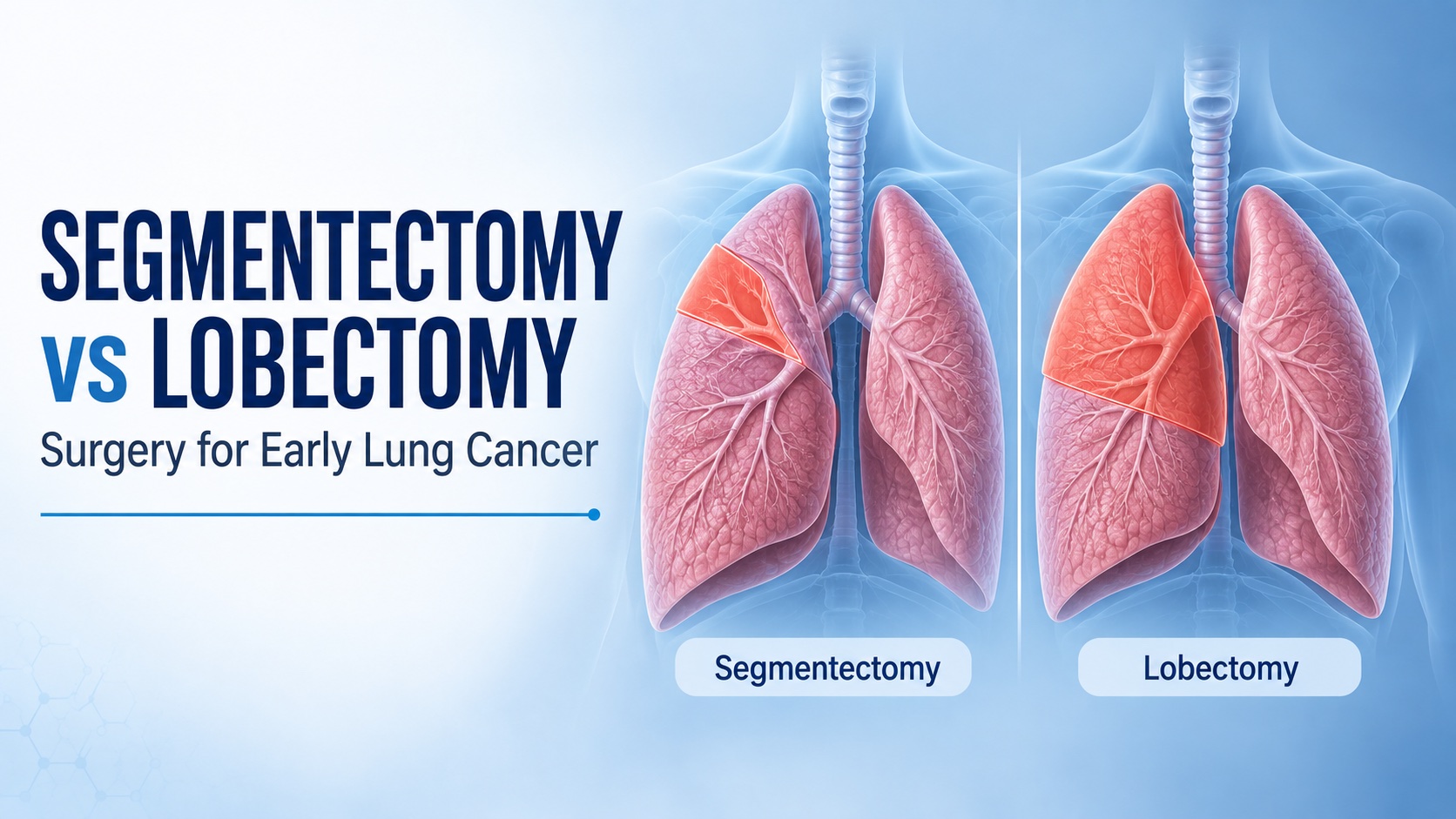
When a small lung cancer is found, the first question is often whether it can be removed. The next question can be just as important: how much lung needs to come out? A recommendation for segmentectomy may sound reassuring because it preserves more lung. A recommendation for lobectomy may sound more extensive than expected. Neither name, on its own, tells you which operation is right for you.
The aim is to remove the cancer adequately while preserving as much useful lung function as possible. That requires looking at the tumour's position, lymph nodes, surgical margins and your breathing reserve together. This guide explains segmentectomy vs lobectomy for early-stage non-small cell lung cancer, the evidence behind these choices, and the questions that make a surgical consultation more useful.
Segmentectomy vs Lobectomy: The Essential Difference
The right lung has three lobes and the left has two. Each lobe contains smaller anatomical units called segments. A lobectomy removes a whole lobe, while a segmentectomy removes one or more segments within a lobe. Both are anatomical resections: the surgeon works with the relevant airway and blood-vessel branches.
A wedge resection is different. It removes a wedge-shaped piece around a lesion without following the boundaries of an entire anatomical segment. Removing one whole lung is called a pneumonectomy. Patients sometimes hear “lung removal” and understandably imagine the latter, so ask the team to describe exactly what is planned. The National Cancer Institute's treatment guide explains these operations.
| Question | Segmentectomy | Lobectomy |
|---|---|---|
| What is removed? | One or more anatomical segments | An entire lung lobe |
| What remains? | The other segments of the affected lobe | The other lobes of the lung |
| Are lymph nodes assessed? | Yes, when treating lung cancer | Yes, when treating lung cancer |
| Can it be minimally invasive? | Yes, in suitable cases | Yes, in suitable cases |
| What decides suitability? | Tumour characteristics, adequate margins and patient fitness | Tumour characteristics, adequate margins and patient fitness |
Why the Choice Has Changed for Some Small Lung Cancers
Lobectomy has long been an established operation for early lung cancer. More recent randomised trials have shown that selected patients can have a smaller resection without compromising the outcomes measured in those studies. The important word is selected: these trials did not include every tumour called “early stage”.
What the CALGB/Alliance 140503 trial found
This trial studied peripheral non-small cell lung cancers no larger than 2 cm, with lymph-node negativity confirmed during surgery. It compared lobectomy with sublobar resection, which included both segmentectomy and wedge resection. At five years, disease-free survival was 63.6% after sublobar surgery and 64.1% after lobectomy; sublobar surgery met the trial's non-inferiority criterion.
Disease-free survival counts both recurrence and death as events. It is not simply the percentage of people whose cancer returned. The study supports less extensive surgery for its eligible population; it does not establish that all small resections are interchangeable in every setting. Read the published CALGB/Alliance results.
What the Japanese segmentectomy trial adds
The JCOG0802/WJOG4607L trial directly compared segmentectomy and lobectomy for selected peripheral cancers measuring 2 cm or less. Its published five-year overall survival was 94.3% with segmentectomy and 91.1% with lobectomy. However, local relapse was more frequent after segmentectomy: 10.5% compared with 5.4%.
Those findings explain why a discussion should cover cancer control, recurrence and retained lung function together. They do not support a blanket claim that removing less tissue is always better. Nor should percentages from two different trials be used to predict an individual patient's survival. Read the JCOG0802 trial report.
Who May Be Suitable for Segmentectomy?
A small cancer near the outer part of the lung, without involved lymph nodes, may be suitable for a lung-sparing operation when it can be removed with an adequate surrounding margin. “Peripheral” matters because a tumour close to the centre of the lung may lie near important airway or vessel branches.
A 2 cm measurement is therefore a starting point for assessment, not an automatic eligibility rule. Your surgeon must understand where the tumour sits within the proposed segment, what the scans suggest about its behaviour and whether the necessary tissue can be removed safely. The NCI's explanation of lung-sparing surgery puts the trial findings in patient context.
Ask the surgeon to show you the lesion on your CT images. If you have only the written report, request access to the actual scan before a second-opinion appointment. A discussion about the operation becomes easier when “small”, “central” and “close to the edge” refer to something you can see.
When Might Lobectomy Be the Better Option?
Lobectomy may be recommended when the cancer is larger, when its position makes a smaller resection unsuitable, or when an adequate cancer-free margin would be difficult to achieve with segmentectomy. More extensive disease can also change the overall treatment plan. A recommendation for lobectomy does not necessarily mean your surgeon has overlooked lung-sparing surgery.
The decision also includes what you can tolerate. Breathing tests and general medical assessment help estimate the consequences of removing lung tissue. Someone with limited breathing reserve may need a different balance of options from someone with strong lung function. The American Cancer Society explains assessment before lung cancer surgery.
A useful question is: “What specific finding makes lobectomy preferable in my case?” Ask for the reason in terms of your tumour and your health, rather than accepting an answer based only on which operation is newer.
Margins, Lymph Nodes and the Final Pathology Report
A clear margin means that the pathologist does not find cancer at the cut edge of the removed tissue. Lymph-node assessment looks for spread beyond the original tumour. These are central parts of cancer surgery, even when the lump itself looks small on imaging.
Before the operation, discuss whether an unexpected finding could require a change in the planned resection. You should understand the circumstances under which a proposed segmentectomy might become a lobectomy, and what decisions the team would make during surgery versus after the final report.
The final pathology report also helps establish the cancer's stage and informs whether additional treatment should be considered. Ask when the report will be available and who will explain it. The Society of Thoracic Surgeons' patient guide describes how surgery fits into lung cancer care. You can also read our overview of stage I lung cancer treatment.
Segmentectomy, VATS and Robotic Surgery Are Different Decisions
Segmentectomy and lobectomy describe the tissue removed. Video-assisted thoracoscopic surgery (VATS), robotic surgery and open surgery describe how the surgeon reaches it. You can therefore have a VATS lobectomy, a robotic lobectomy, or a segmentectomy performed through a suitable minimally invasive approach.
VATS uses a camera and instruments through small incisions. Robotic surgery uses a surgeon-controlled platform. An open operation uses a larger incision and may be necessary in some circumstances. The equipment does not replace the need for adequate cancer removal or appropriate lymph-node assessment.
Cancer Research UK describes the surgical approaches. Our VATS, robotic and open lung surgery comparison explains that separate choice in more detail.
What If Surgery Is Not Suitable?
Being diagnosed with early lung cancer does not automatically mean an operation is safe. Significant heart or lung disease may make the risk too high. A multidisciplinary team can discuss alternatives, including stereotactic body radiotherapy for appropriate early-stage cancers.
A smaller operation is not a universal solution to poor surgical fitness. Ask whether the alternatives have been reviewed and why the proposed treatment offers the most reasonable balance for you. Memorial Sloan Kettering's guide discusses surgical suitability and non-surgical options.
Preparing for Either Operation
Your pre-operative visit checks fitness for surgery and anaesthesia. Tests may include blood work, an ECG and lung-function testing, with additional investigations according to your health. Bring all medicines, inhalers and supplements on a written list; obtain specific instructions about fasting and which treatments to continue or pause.
Preparation may also include stopping smoking, improving nutrition and activity, and learning breathing exercises. These measures should fit the time available before treatment and your team's advice. Arrange transport, time away from work and help at home before admission. Cancer Research UK's preparation guidance explains these steps.
Our lung surgery checklist can help you organise the practical details. Take it to the appointment and mark the instructions that apply to your own operation.
Risks: A Smaller Resection Is Still Major Surgery
Both operations can involve bleeding, infection, blood clots, an air leak from the remaining lung and breathing problems. An ongoing air leak may prolong the need for a chest drain. Some patients have persistent discomfort around the incision or need longer to recover their stamina.
Risk depends on more than the operation's name. Ask which complications are most relevant to your health, how the team reduces them and what the plan would be if they occur. Cancer Research UK outlines possible post-operative problems.
After discharge, sudden severe breathlessness, severe chest pain or fainting requires emergency assessment. Fever, worsening wound redness or discharge, and pain that is becoming harder to control should be reported promptly. Keep the hospital contact details with your medicines and discharge papers.
Recovery After Segmentectomy or Lobectomy
In hospital
You will be monitored after anaesthesia and may have a chest drain to remove air and fluid. Staff help with pain relief, breathing exercises and getting up safely. Drain removal and discharge depend on clinical progress rather than a fixed number of days.
Pain control supports deep breathing and movement. Tell the team if pain prevents either; silently tolerating it does not help recovery. This guide to care after lung cancer surgery explains the early hospital period.
At home
Plan for a gradual return to activity. Short walks, rest periods and following the prescribed exercise plan are more useful than comparing yourself with another patient. Ask for individual guidance on lifting, driving, work and travel. A segmentectomy does not guarantee an earlier return to all activities than a lobectomy.
Before leaving hospital, clarify four practical details: how to take your medicines, how to care for the wound, whom to contact with concerns, and when your next appointment is due. Ask a family member to listen to the instructions if they will be helping you at home.
Follow-up Remains Important After Successful Surgery
Removing the tumour is a major treatment step, but it does not end follow-up. Appointments review healing, symptoms, scan findings and whether any further cancer treatment is needed. Your team sets the surveillance schedule according to the diagnosis and treatment plan.
Keep a copy of the pathology report and a record of your operation. If symptoms change between visits, contact the team instead of waiting for a routine scan. Cancer Research UK explains follow-up after lung cancer treatment.
Frequently Asked Questions
Is segmentectomy better than lobectomy for every stage I cancer?
No. Trials support segmentectomy or other sublobar surgery in selected small peripheral cancers. Tumour position, margins, lymph nodes and fitness still determine suitability. Ask how closely your situation matches the patients in the studies.
Is segmentectomy the same as a wedge resection?
No. Segmentectomy follows anatomical segment boundaries; a wedge removes a piece around a lesion. Both remove less than a whole lobe, but the procedures and reasons for choosing them differ.
Will I need chemotherapy after either operation?
The operation's name alone cannot answer that. Final stage, pathology and other tumour features guide discussion of further treatment. Ask when your results will be reviewed by the cancer team.
Can I get a second opinion without repeating every test?
Bring the existing CT and PET-CT images, biopsy report, pathology material if requested, breathing tests and treatment summary. The reviewing team can tell you what is sufficient and whether a particular missing or outdated investigation needs repeating.
Discussing Lung Cancer Surgery in Gurgaon
For a consultation with Dr. Parveen Yadav, write down the exact operation you have been offered and the reason given. Bring your scan images as well as reports, and describe the activities you most want to return to after treatment.
Ask three questions before leaving: why this amount of lung should be removed, what could change the plan, and what the next step is. Book a consultation for an individual review of your lung cancer surgery options.
Cover: AI-generated conceptual medical illustration created for this article; not a patient scan or surgical planning diagram.

Dr. Parveen Yadav
18+ Yrs Exp | 5,700+ Thoracic & Robotic Cancer Surgeries
Dr. Parveen Yadav is a Director and Senior Consultant in Thoracic and Surgical Oncology, specializing in minimally invasive and robotic lung and esophageal surgeries, with advanced training from AIIMS and Tata Memorial Hospital.
View Full ProfileRecent Posts

Chest Drain After Lung Surgery: Care, Removal and Recovery
- Dr. Parveen Yadav
- Oct 10, 2026

EBUS Biopsy: What to Expect and How It Helps Stage Lung Cancer
- Dr. Parveen Yadav
- Oct 06, 2026

Rib Pain When Coughing: Causes, Warning Signs and Treatment
- Dr. Parveen Yadav
- Oct 02, 2026

Food Stuck in Chest: Causes, Warning Signs and When to Get Help
- Dr. Parveen Yadav
- Sep 28, 2026
Related Posts
EBUS Biopsy: What to Expect and How It Helps Stage Lung Cancer
Learn why EBUS biopsy is used to sample chest lymph nodes, how to prepare, what recovery involves and how results help guide lung cancer treatment.
- Read More
- Oct, 06 2026

A Lung Nodule on CT Scan: What Happens Next?
A clear guide to lung nodules found on CT scans: what they are, why many are benign, and how specialists decide on follow-up, PET-CT or biopsy.
- Read More
- Sep, 08 2026
Surgery vs. Endoscopic Resection for T2N0M0 Lung Cancer: What’s the Safer Option?
T2N0M0 lung cancer diagnosis? Compare surgery vs. non-surgical options like SBRT. Learn about safety, survival rates, and what's the safer choice for you.
- Read More
- Aug, 20 2026
Copyright 2026 © Dr .Parveen Yadav all rights reserved.
Proudly Scaled by Public Media Solution!