


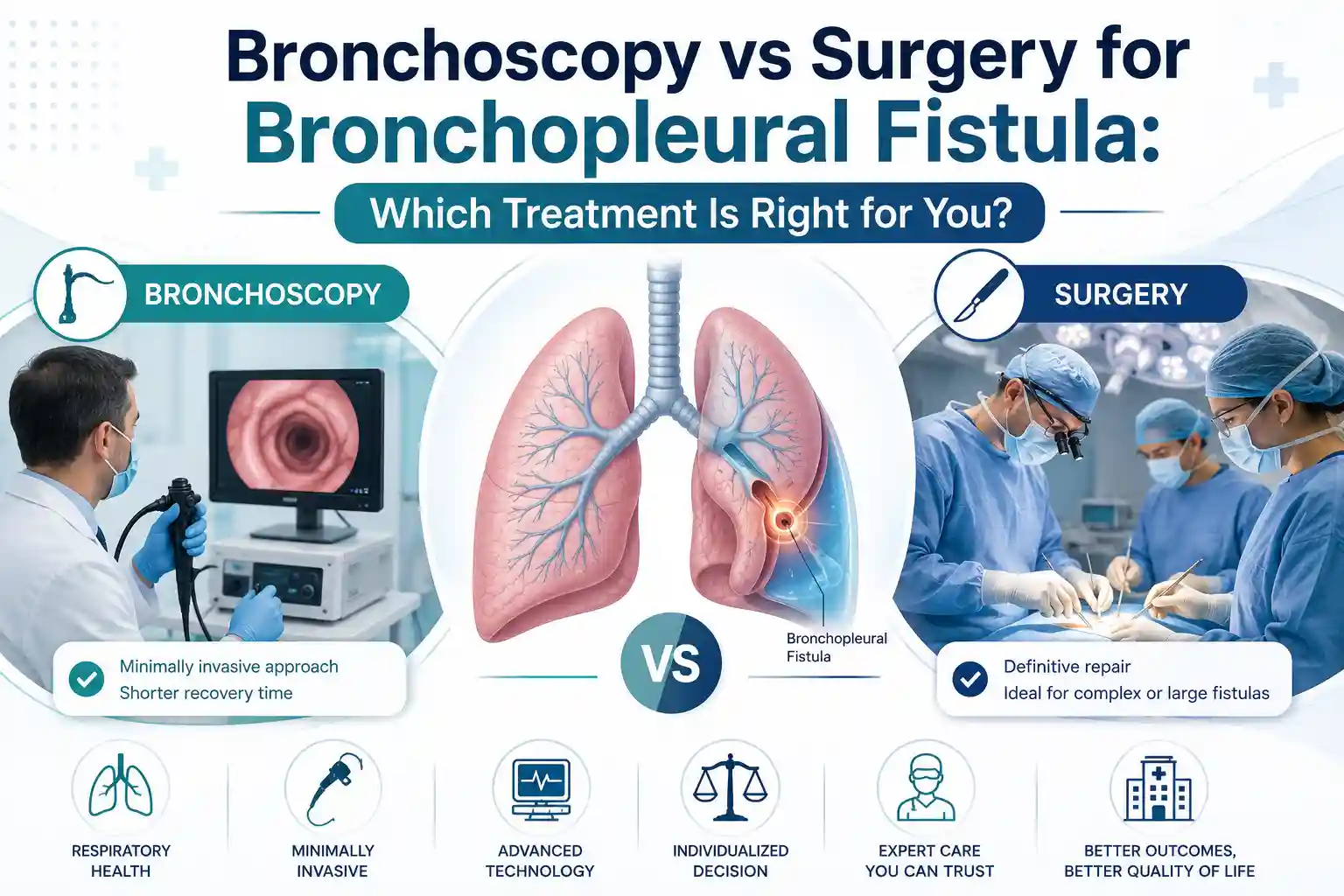
When you are diagnosed with a bronchopleural fistula, one of the first questions you and your family will face is what kind of treatment is best. Some patients respond well to a minimally invasive bronchoscopic procedure, while others need full surgical repair. The right answer depends on the size of the fistula, your overall health, and how quickly the problem is caught. If you are exploring bronchopleural fistula treatment in Gurgaon, this guide breaks down both options side by side so you can have a clear, informed conversation with your thoracic surgeon.
A bronchopleural fistula is an abnormal connection between the airway and the pleural space around the lung. According to a review published in SAGE Journals, BPF requires immediate attention because it can lead to severe respiratory complications and infections, such as empyema. Choosing the right procedure at the right time often decides whether recovery is smooth or prolonged.
Two main paths exist:
Both have their place. Neither is universally better.
Bronchoscopy uses a thin flexible scope passed through the mouth or nose to reach the fistula. The surgeon then seals the opening using one of several techniques.
Bronchoscopic closure works best when:
A peer-reviewed paper on Springer Nature notes that most BPF patients who already had a lung resection are too weak to tolerate another major operation, which is exactly why bronchoscopic methods have become a leading option.
A systematic review on PMC reported that embolization coils achieved an 80% complete closure rate for postoperative BPFs measuring 2 to 3.1 millimeters. Amplatzer devices have also shown strong long-term outcomes, with a study on PubMed following 31 patients over an average of 17.6 months with encouraging results.
Surgical repair is the traditional gold standard, especially for large or persistent fistulas. The operation can be open thoracotomy, video-assisted thoracoscopic surgery (VATS), or robotic-assisted surgery, depending on the case.
The surgeon first cleans out the infected pleural space, then closes the bronchial stump and reinforces it with healthy tissue. Reinforcement is usually done with:
Pleurodesis is often performed to fuse the pleural layers and prevent fluid buildup.
Surgical repair is favored when:
A study on PMC found that fistula diameter and the type of suture used during the original surgery are critical determinants of BPF closure success, which is why larger fistulas often require a structured surgical approach.
| Factor | Bronchoscopy | Surgery |
| Best for fistula size | Small, under 8 mm | Larger, above 8 mm |
| Hospital stay | 2 to 5 days | 7 to 14 days |
| Recovery time | 1 to 2 weeks | 4 to 8 weeks |
| Pain level | Low | Moderate to high |
| Patient fitness needed | Lower | Higher |
| Definitive outcome | Sometimes repeat needed | Usually one procedure |
| Suitable for chronic infection | Limited | Strong fit |
Your thoracic surgeon will weigh several factors:
In many real-world cases, the two approaches are combined. A bronchoscopic procedure may initially control symptoms, followed by surgery once the patient is stable.
Both bronchoscopy and surgery have excellent published outcomes. Still, the surgeon's experience often matters more than the technique itself. Dr. Parveen Yadav, Chief and Senior Consultant in Thoracic Surgery and Surgical Oncology at Artemis Hospital, Sector 51, Gurgaon, has performed over 5,700 major thoracic procedures over 18+ years of practice. His exposure to both minimally invasive bronchoscopic techniques and robotic thoracic surgery means patients in Gurgaon and Delhi NCR get tailored decisions rather than a one-size-fits-all approach.
This kind of judgment, knowing when to choose endoscopy and when to recommend surgery, is what separates a good outcome from an avoidable complication.
A bronchopleural fistula deserves a careful, individualized plan. Do not settle for a generic recommendation.
Call +91 9540210956 to speak with Dr. Parveen Yadav's clinic, or book a consultation in Gurgaon online. If you are in another city, a free second opinion from a thoracic surgeon is available so you can compare treatment options before committing.
Your decision today shapes the next year of your recovery. Choose carefully.
FAQs
Is bronchoscopy always safer than surgery for BPF?
Bronchoscopy is less invasive but not automatically better. For large or chronic fistulas, surgery offers a more definitive result.
Can both bronchoscopy and surgery be used together?
Yes. In many cases, bronchoscopic sealing is used to stabilize the patient before a planned surgical repair.
How soon after the BPF appears should treatment start?
As soon as the diagnosis is confirmed. Delays raise the risk of pneumonia, empyema, and sepsis.
Is robotic surgery available for BPF repair in Gurgaon?
Yes. Robotic and VATS approaches are performed at tertiary hospitals in Gurgaon, including by experienced thoracic surgical oncologists like Dr. Parveen Yadav.
What is the average cost difference between the two treatments?
Costs vary by hospital, fistula complexity, and length of stay. Generally, bronchoscopic procedures are less expensive due to shorter hospitalization, but a personal estimate is the only reliable figure.

18+ Yrs Exp | 5,700+ Thoracic & Robotic Cancer Surgeries
Dr. Parveen Yadav is a Director and Senior Consultant in Thoracic and Surgical Oncology, specializing in minimally invasive and robotic lung and esophageal surgeries, with advanced training from AIIMS and Tata Memorial Hospital.
View Full Profile
Robotic vs VATS lobectomy? An expert guide to choosing the best lung cancer treatment in Gurgaon & Delhi. Learn the pros, cons, and key differences.
A lung cancer diagnosis is overwhelming. A second opinion can confirm your path, find better treatments, and give you critical peace of mind. Learn why
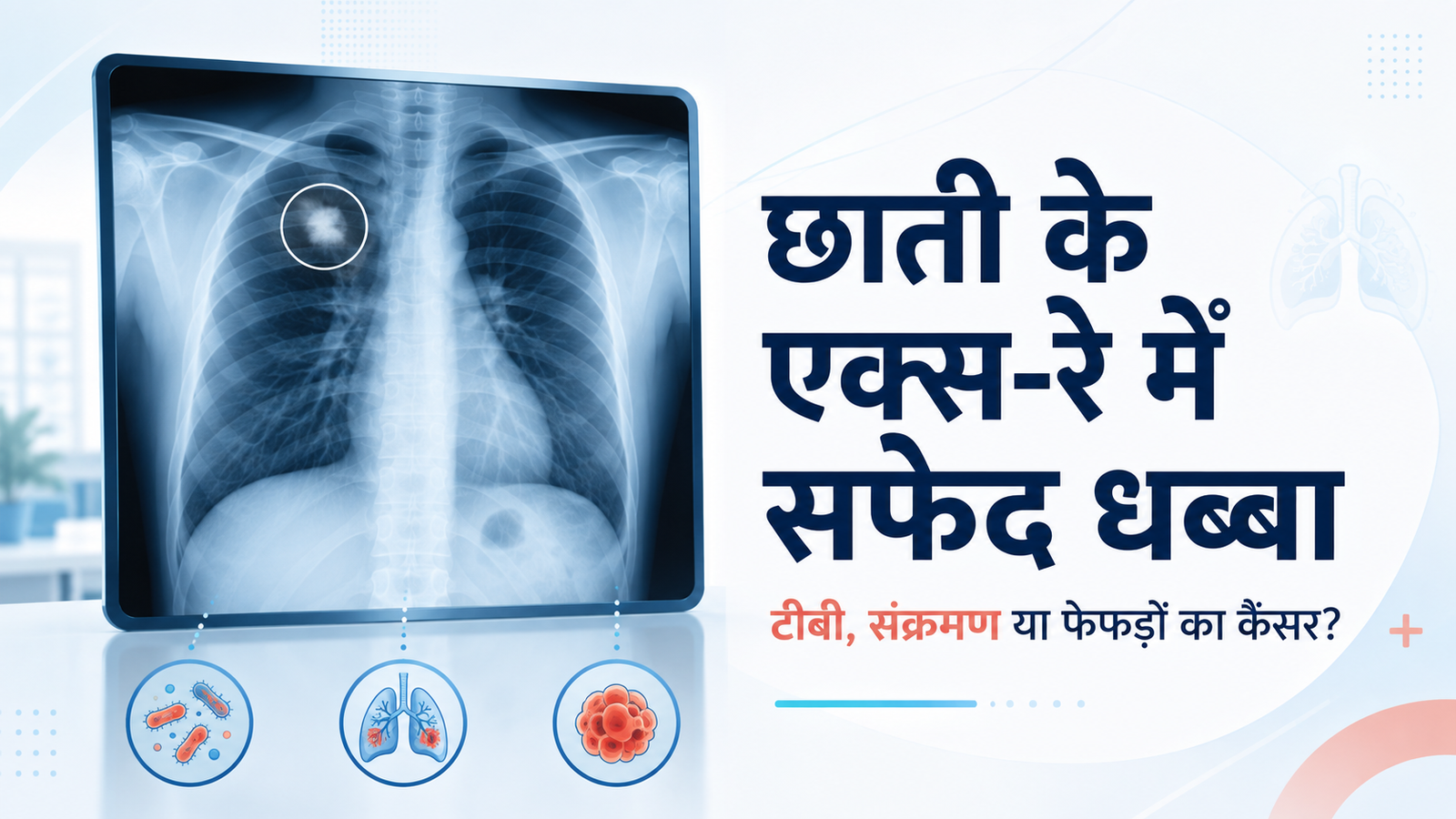
छाती के X-Ray में सफेद धब्बा दिखने का मतलब हमेशा कैंसर नहीं होता। जानें इसके संभावित कारण, टीबी और लंग कैंसर में अंतर तथा जरूरी जांच।
Copyright 2026 © Dr .Parveen Yadav all rights reserved.
Proudly Scaled by Public Media Solution!